Staraya derevnya
Russian experimental band blending krautfolk with improvised animated projections.
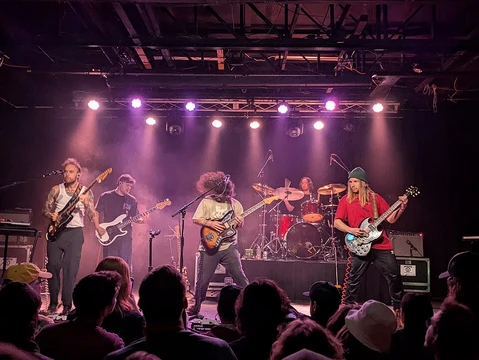
Staraya derevnya (Russian: Старая деревня, meaning "Old village") is an experimental psychedelic band formed in 1994. The group takes its name from a historic district in Saint Petersburg. They describe their sound as "krautfolk," built around free-form jams, hypnotic rhythms, and a wide-ranging assortment of instruments. During live shows, the band performs in near-complete darkness, directing the audience's focus toward animated paintings that are projected and created spontaneously alongside the music.
- field
- Experimental psychedelic music
- nationality
- Russian
- known_for
- Self-defined 'krautfolk' style, live performances in near-total darkness with improvised animated projections
- active_since
- 1994
Lore & Background
Staraya derevnya has been active since 1994, taking its name from a historic district of Saint Petersburg. The band's self-defined genre 'krautfolk' is built on free-form jams, hypnotic rhythmic patterns, and an eclectic mix of instruments. Their live shows are distinctive for being performed in near-total darkness, with the audience's attention directed to animated paintings that are improvised in real time alongside the music.
The group's discography includes studio albums such as 'Garden window escape' (2025), 'Boulder blues' (2022), and 'Inwards opened the floor.' (2020), as well as live albums like 'Blue forty-nine' (2023) and 'Live at Cafe Oto 13.10.17' (2018). They have also released compilations including 'Forgot what was important' (2022) and 'A view from a hill' (2017), and singles such as 'I'm thicket' (2008) and 'Onelegged' (2007).
Reader's Guide
Staraya derevnya occupies a unique niche in experimental music, blending psychedelic and folk elements into a self-defined 'krautfolk' sound. Their approach to live performance—playing in near-total darkness while projecting improvised animated paintings—creates an immersive, multi-sensory experience that distinguishes them from conventional concert acts. The band's longevity since 1994 and their consistent output across studio albums, live recordings, and compilations demonstrate a sustained commitment to their artistic vision. Their discography, including collaborations such as 'Still life with apples' with Hans Grusel's Krankenkabinet, reflects an openness to cross-genre experimentation. While not widely known in mainstream circles, Staraya derevnya's work has been released on various independent labels, suggesting a dedicated underground following. Their significance lies in their fusion of music and visual art, challenging traditional boundaries between performer and audience, and their role in the broader landscape of experimental and psychedelic music.
Did You Know?
- The band's name translates to 'Old village' in Russian and is named after a historic district of Saint Petersburg.
- Their music style is self-defined as 'krautfolk'.
- Live performances are played in near-total darkness with projected animated paintings improvised alongside the music.
- The band has been active since 1994.
Origins & Self-Defined Identity
Staraya derevnya, translating from Russian as "Old village," takes its name from the historic district of Saint Petersburg that carries the same title. Active since 1994, the band has maintained a continuous presence in the experimental and psychedelic music world for over three decades. The group deliberately coins its own genre term—"krautfolk"—to characterize a sound built on free-form jamming, hypnotic rhythmic patterns, and an eclectic mix of instruments that resists easy categorization. This self-definition reflects a conscious choice to define their artistic territory on their own terms rather than accepting external labels. The naming after a specific Saint Petersburg neighborhood grounds the project in a particular cultural and geographic context, even as the musical language reaches well beyond any single tradition. Their sustained activity from the late 1990s through the mid-2020s, with releases spread across numerous independent labels, underscores a career driven by artistic conviction and a commitment to the underground rather than mainstream commercial ambition.
Theatrical Live Performances
What distinguishes Staraya derevnya's concerts from a typical band set is the deliberate stripping away of visual distraction. Performances are staged in near-total darkness, a choice that fundamentally reorients the audience's sensory focus. In the absence of conventional stage lighting and visual spectacle, listeners are guided instead toward projected animated paintings that are improvised in real time alongside the music. The visual component is not a pre-recorded video or a fixed backdrop; it is created collaboratively and simultaneously with the sonic performance, meaning the imagery and the sound emerge together as a single, unrepeatable event. This approach transforms a concert from a passive listening experience into a multisensory encounter where rhythm, improvisation, and visual narrative are inseparable. The hypnotic rhythmic patterns that define the band's studio work gain an additional dimension on stage, as the audience's eyes follow evolving painted forms while their ears track the free-form jams unfolding in the dark. The result is a performance that privileges collective, in-the-moment creation over rehearsed precision.
A Decades-Long Discographic Journey
Staraya derevnya's recorded output spans from the late 1990s to the present day, tracing a career of steady, independent release. Their earliest documented studio album, Expedition, appeared in 1999 and was later remastered for a 2009 reissue, indicating a return to earlier material as the band's profile evolved. Subsequent studio releases include From inside the log (2010), Kadita sessions (2016), Inwards opened the floor (2020), Boulder blues (2022), and Garden window escape (2025), the latter issued on both Ramble records and Auris Media records. The band has also documented their live work on albums such as Live at Cafe Oto (2018), Oto / Tusk (2020), and Blue forty-nine (2023). Beyond full-length records, their catalog includes singles like Onelegged (2007) and I'm thicket (2008), as well as a series of compilations released on labels ranging from Bomba-Piter to Linear Obsessional Recordings and Weakie Disks. This breadth of formats and the rotation of independent labels across three decades reflect a project that values variety and artistic freedom over a fixed commercial identity.
Collaboration & Cross-Pollination
While Staraya derevnya maintains a distinct artistic identity, their discography reveals a willingness to cross boundaries through collaboration. A notable example is Still life with apples (2020), a joint project with Hans Grusel's Krankenkabinet, released on Steep Gloss. This partnership demonstrates the band's openness to merging their krautfolk sensibility with another artist's distinct vision, producing a work that sits outside either project's solo catalog. The band's choice of labels further illustrates this cross-pollinating ethos: releases have appeared on Ramble records, Raash records, Steep Gloss, Blue tapes, TQN-aut, OTORoku, Linear Obsessional Recordings, Weakie Disks, Bomba-Piter, and Auris Media records, among others. Each label likely brings its own audience and aesthetic context, exposing the band's music to diverse listener communities. The inclusion of a compilation titled Сеть-5 Альмагест (2001) on Bomba-Piter, a Russian label, alongside English-titled releases on European and international imprints, suggests a career that navigates between local and global scenes. This network of affiliations positions Staraya derevnya as a connective thread within the broader experimental and psychedelic underground.
Gallery
More in Psychedelic musical groups 1-18
Spotted an error? Know more?
This is a living reference — every entry is fact-audited, and reader corrections feed straight into our audit queue. Suggest an edit · See this site's audit record