Spirit (band)
American rock band known for "I Got a Line on You."
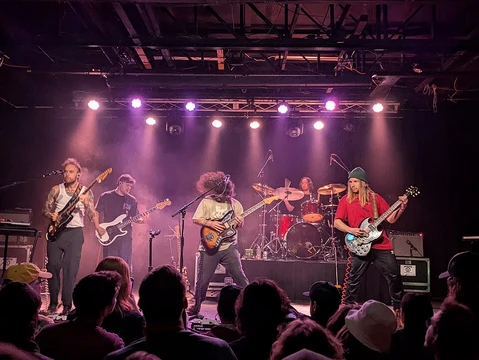
Spirit was an American rock band formed in 1967 in Los Angeles. They are best known for their single "I Got a Line on You" and for albums such as their self-titled debut, The Family That Plays Together, Clear, and Twelve Dreams of Dr. Sardonicus. The original lineup evolved from the Red Roosters and included Randy California, Mark Andes, Jay Ferguson, Ed Cassidy, and John Locke.
- formed
- 1967
- origin
- Los Angeles, California, United States
- genre
- Rock
- known_for
- Single "I Got a Line on You" and album Twelve Dreams of Dr. Sardonicus
- label
- Ode Records, Epic Records
Lore & Background
The band's original lineup grew from the Red Roosters, which included Randy California, Mark Andes, and Jay Ferguson. Ed Cassidy, California's stepfather and a former jazz drummer, joined on drums, and John Locke played keyboards. The group was initially named the Spirits Rebellious after a book by Kahlil Gibran, then shortened to Spirit. Before returning to California, Randy California had played with Jimi Hendrix in New York City in 1966, and Hendrix gave him the nickname "Randy California" to distinguish him from another guitarist.
In August 1967, producer Lou Adler signed the band to Ode Records. Their debut album, Spirit, was released in 1968 and reached number 31 on the Billboard 200. The single "I Got a Line on You" became their biggest hit, reaching number 25. The band appeared at the Denver Auditorium in December 1968 with support act Led Zeppelin. Jimmy Page's use of a theremin has been attributed to seeing Randy California use one. Guitar World noted that California's fingerpicked acoustic theme from "Taurus" was accused of being copied for the introduction to "Stairway to Heaven." A 2014 copyright infringement suit against Led Zeppelin was unsuccessful; the verdict was overturned on appeal in September 2018, then reinstated in March 2020.
After the album Clear, the group recorded the song "1984," which reached number 69 on the Billboard chart. In 1970, they worked on Twelve Dreams of Dr. Sardonicus with producer David Briggs. The album peaked at number 63 and is regarded as a landmark of art rock. Following a promotional tour, Ferguson and Andes left to form Jo Jo Gunne. The remaining members—Cassidy, Locke, and new members Al and Chris Staehely—recorded Feedback in 1972. California released a solo album, Kapt. Kopter and the (Fabulous) Twirly Birds, in 1972.
Reader's Guide
Spirit's significance lies in their blend of rock, jazz, and psychedelic influences, and their role in the late-1960s Los Angeles music scene. Their most commercially successful single, "I Got a Line on You," remains a classic rock staple. The album Twelve Dreams of Dr. Sardonicus is critically acclaimed for its thematic depth and innovative production, including early use of a modular Moog synthesizer. The band's legacy also includes a notable legal dispute: the fingerpicked acoustic theme from their song "Taurus" was alleged to have been copied by Led Zeppelin for the introduction to "Stairway to Heaven." This led to a copyright infringement suit filed in 2014, which was initially unsuccessful, then overturned on appeal in 2018, and later reinstated in 2020. Spirit's influence extends to their pioneering exploration of environmental themes in lyrics and their use of the theremin, which Jimmy Page adopted after seeing Randy California perform with one.
Did You Know?
- Randy California was given his nickname by Jimi Hendrix to distinguish him from another guitarist named Randy Palmer, whom Hendrix called 'Randy Texas.'
- Ed Cassidy, the drummer, was about twenty years older than the rest of the group and had previously played jazz with Cannonball Adderley, Gerry Mulligan, and Thelonious Monk.
- The band's early demo recordings were produced by Barry Hansen, later known as the radio host Dr. Demento.
- The song 'Taurus' was the subject of a copyright infringement suit against Led Zeppelin over the introduction to 'Stairway to Heaven,' with the verdict being overturned on appeal in 2018 and reinstated in 2020.
Origins and Formation
Spirit emerged from the Los Angeles music scene in 1967, growing out of a group called the Red Roosters. The core trio—Randy California on guitar and vocals, Mark Andes on bass, and Jay Ferguson on vocals and percussion—was joined by Ed Cassidy on drums and John Locke on keyboards. The name "Spirits Rebellious" was borrowed from a Kahlil Gibran book before being trimmed to simply Spirit. California's path was unusual: in 1966, he had played alongside Jimi Hendrix in Jimmy James and the Blue Flames in Greenwich Village, where Hendrix dubbed him "Randy California" to separate him from a fellow guitarist named Randy Palmer, whom Hendrix called "Randy Texas." Cassidy, born in 1923, brought a wealth of jazz credentials—having played with legends like Thelonious Monk and Cannonball Adderley—and was also the founding drummer of Rising Sons, an early blues-rock project featuring Taj Mahal and Ry Cooder. His shaved head earned him the nickname "Mr. Skin," which later became a Spirit song title.
Commercial Peak and the Led Zeppelin Connection
Spirit's commercial breakthrough arrived in 1968 with their self-titled debut, which climbed to number 31 on the Billboard 200 and spent seven months on the chart. The follow-up single "I Got a Line on You," released in November 1968, became their biggest hit, peaking at number 25 in the US and number 28 in Canada, while the album The Family That Plays Together reached number 22. In December 1968, Spirit shared the Denver Auditorium stage with a young Led Zeppelin, and the two bands also appeared together at two outdoor festivals in July 1969. The connection deepened musically: Jimmy Page's theremin work has been linked to watching California mount one to his amplifier. More controversially, Guitar World suggested that the fingerpicked acoustic intro to "Stairway to Heaven" closely mirrored California's "Taurus." In 2014, Mark Andes and a trust representing California filed a copyright infringement suit seeking a writing credit. Page denied the claim, the suit failed, but the verdict was overturned on appeal in 2018, only for the Ninth Circuit to reinstate the original jury decision in March 2020.
Twelve Dreams of Dr. Sardonicus and Art Rock Vision
Recorded in 1970 with producer David Briggs—chosen on Neil Young's recommendation from their shared Topanga Canyon roots—Twelve Dreams of Dr. Sardonicus stands as one of rock's most ambitious art-rock statements. The album weaves literary themes about life's fragility and human complexity, punctuated by the recurring line "life has just begun," and extends the band's earlier environmental concerns seen in "Fresh Garbage." Its production was groundbreaking for its era, featuring a modular Moog synthesizer, and critics have placed it in the same tier as The Who's Tommy and Pink Floyd's The Dark Side of the Moon. The song "1984," written by California and self-produced, charted modestly at number 69 on Billboard before finding wider release on The Best of Spirit in 1973; it was later covered by Nash the Slash on his 1984 album American Band-ages. "Nature's Way," another California composition, was reportedly written in a single afternoon during a Fillmore West engagement. Despite peaking at only number 63 in the US, the album cemented Spirit's reputation as serious artists.
Internal Fractures and Dissolution
The band's trajectory shifted dramatically after the Sardonicus era. In late 1969, Lou Adler moved Ode Records' distribution from Columbia to A&M, and as part of the termination agreement, Columbia retained Spirit under contract, shifting future releases to Epic. The label instability compounded growing internal tensions. After a promotional tour supporting Twelve Dreams of Dr. Sardonicus, Ferguson and Andes departed to form Jo Jo Gunne. California accused them of scheming to seize control of the group. Their final performance together on January 30, 1971, nearly erupted into a physical altercation. John Arliss stepped in to replace Andes on bass, but the damage to the group's cohesion was already done. What had begun as a tight-knit unit in Topanga Canyon—roommates sharing early demos produced by Barry Hansen, later known as radio personality Dr. Demento—had fractured beyond repair, leaving California to navigate a changed musical landscape with a diminished lineup.
Gallery

More in Psychedelic musical groups 1-18
Spotted an error? Know more?
This is a living reference — every entry is fact-audited, and reader corrections feed straight into our audit queue. Suggest an edit · See this site's audit record